Camouflage (۲۰۱۸)
About Piece
In late winter of 2017, I encountered Ali Akbar Sadeghi‘s paintings at the Tehran Museum of Contemporary Art. I was deeply impressed when I came across a series of these paintings, displayed as a collection titled “Camouflage.” In these canvases, various elements like soldiers, umbrellas, crows, etc., were arranged on the page in different states and colors, following a specific, repetitive pattern. However, two crucial aspects were present in all the paintings: first, a starkly contrasting element would draw attention, and second, subtle contrasts in the state or color of the elements existed that weren’t immediately visible. It was as if these elements were concealing themselves from our view, and the presence of that large contrasting element and the repetitive pattern made their camouflage easier.
Pondering these issues while encountering these paintings sparked a question in my mind: How can sounds camouflage themselves within a musical piece? Around that time, I was learning the Csound programming language, and I decided to work on the idea of camouflage, write a piece using Csound, and participate in the third year of the Reza Korourian Award Electroacoustic Music Composition Competition.
The piece “Camouflage,” written for cello and live electronics (in a quadraphonic format, meaning for four loudspeakers), consists of three main sections. The first section is a six-voice canon. This canon is made possible by repeating the recorded cello sound and replaying it through the computer. Five delayed voices are presented at 10-second intervals from each other after the main voice, collectively creating a six-voice canon. The arrangement of such a configuration was done with Csound.
In the first part, contrasting figures are presented. Each of these figures lasts approximately 10 seconds, so the formation of the canon by combining different figures creates a polyphonic texture. Simultaneously, the canon sounds gradually rotate clockwise and regularly between the output channels (loudspeakers), which are placed in the four corners around the listeners.
This process continues for a while until all sounds suddenly cut off, and only one sound remains. This section acts like a bridge, connecting the first and second parts of the piece. In the second part, we again have a six-voice canon, but this time the movement of sounds happens randomly between the channels, and the timing between delays is also randomized and much more condensed than the initial canon. Furthermore, the pitch of the delayed sounds constantly changes randomly between two thresholds. In this section, the performer is asked to improvise using the figures introduced in the first part. They are free to expand on the figures and combine them. The sound the performer hears from the Csound output can certainly influence their improvisation. In their rehearsals with the computer for this piece, the performer experiences the computer’s response behaviors and can visualize how a sonic figure in this section is altered by the computer and distributed among different speakers.
The second part, which resembles chaos, gradually thins out, and the familiar sound with which the piece began is heard again. From here, the third part of the piece begins. In this section, the opening six-voice canon of the piece is precisely replayed by the computer. Therefore, in this instance, the performer has no role in creating this canon, but they are going to do something very important: hide their sonic ideas—inspired by the figures introduced in the first part—among the sounds of the canon. In fact, camouflage happens here. On the surface, what is heard is an exact replay of the initial canon, but if one pays close attention (perhaps it’s necessary to listen to the piece several times for clarity), the listener can gradually hear new occurrences that were not present in the first part of the piece. Just as, by focusing on Ali Akbar Sadeghi’s “Camouflage” paintings, one can gradually discover subtle changes that were not apparent at first glance.
In this way, using the possibilities that technology, in this case Csound, provided me, I tried to correlate my understanding of a painting with music. I believe, “It doesn’t matter if my understanding of the painting was exactly what the painter had in mind. And similarly, I should not worry if my audience receives exactly what I had in mind when creating my piece. In my opinion, in contemporary art, the audience is much freer to have their own perception of the work. Therefore, as long as my work attracts my audience as an intellectual stimulus, I have been successful in my work.”
Performance
“Camouflage” has been performed twice so far. The first time was by Alla Shokodko in Mashhad, and the second time by Ulrike Brand (Professor of Cello at the University of Berlin) on September 8, 2018, in Avini Hall at the University of Tehran, as part of the concert featuring selected works from the 3rd Korourian Award at the 2nd Tehran International Electronic Music Festival (TIEMF 2018). Since most people don’t have the setup to listen to music in 4 channels at home, I’ve provided the downmixed two-channel file below. If you’d like to listen to the original 4-channel file, please email me.
Alla Shokodko’s performance:
Ulrike Brand’s performance:
Score
CamouflageCD
The piece “Camouflage” was released in 2019 on a CD with the same title by the Yarava Music Group, alongside works by other winners of this competition.
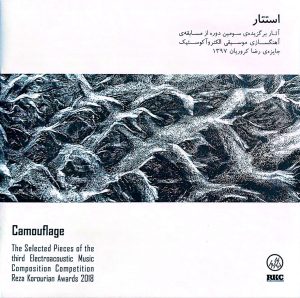
To get a physical copy of the CD, you can contact Yarava Music Group, or you can listen to it on Spotify.
Csound File
Festival Brochure (TIEMF 2018)
For English go to the end of the file.
Festival Brochure (DIFFRAZIONI 2018/2019)
The audio file of the piece “Camouflage” was also performed at the Diffrazioni Festival in Italy in 2018/2019.
Information regarding my piece can be found on page 40 of the PDF file.